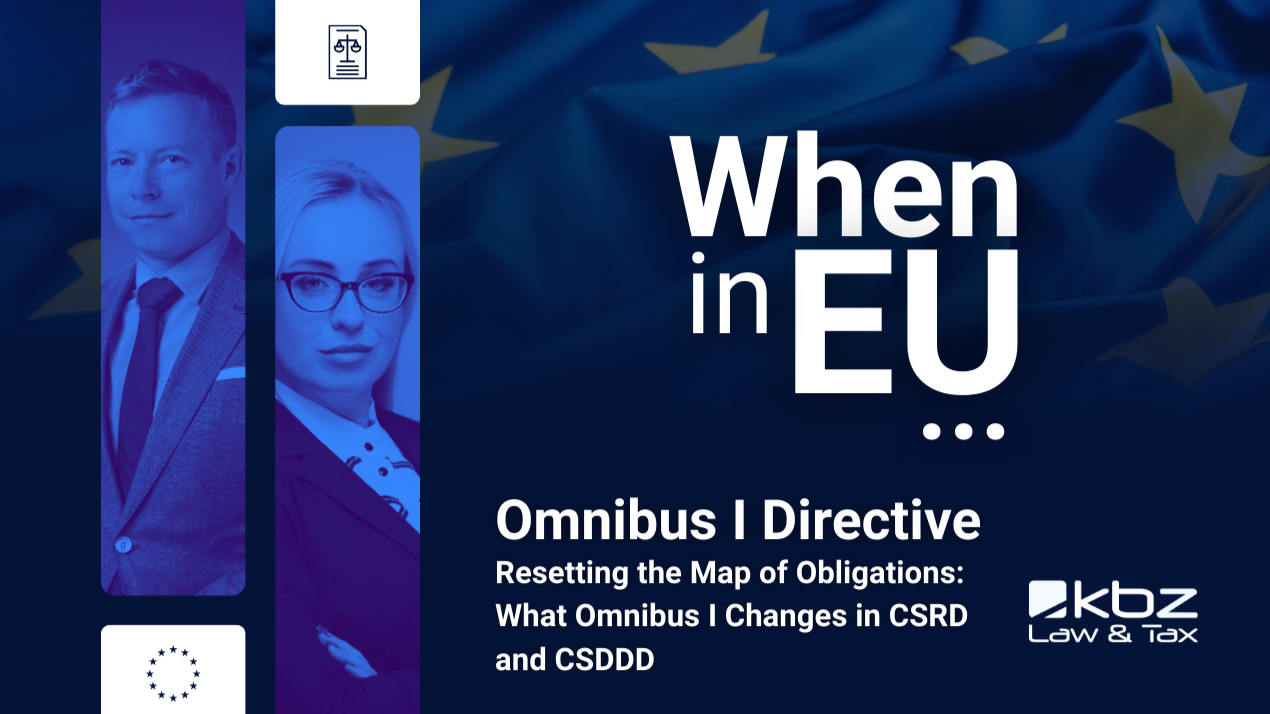

When in EU | Resetting the Map of Obligations: What Omnibus I Changes in CSRD and CSDDD
Over 50,000 companies across the EU are currently preparing for ESG reporting based on thresholds that are about to become obsolete.
Directive (EU) 2026/470, known as Omnibus I, entered into force on 18 March 2026 and introduces a fundamental redesign of two key pillars of the EU ESG framework: the Corporate Sustainability Reporting Directive (CSRD) and the Corporate Sustainability Due Diligence Directive (CSDDD).
For many companies – and their advisors – this means one thing: a full reassessment of what has already been planned.
The reform operates on three levels:
1.New CSRD thresholds
The obligation to prepare and publish sustainability reports will be limited exclusively to large undertakings employing, on average, more than 1,000 employees.
Entities below this threshold will be protected against excessive information requests from larger companies within the value chain. The upper limit of such requests will be defined by the voluntary VSME standard developed by EFRAG.
2.Simplified due diligence under CSDDD
Due diligence obligations will, as a rule, be limited to a company’s own operations, its subsidiaries, and its direct business partners.
Deeper tiers of the value chain will no longer be subject to mandatory assessment. Monitoring cycles will be extended from 1 year to 5 years.
This marks a significant shift for business partners within supply chains – including SMEs – which previously faced the risk of annual information requests.
Instead of mandatory termination of business relationships in case of identified breaches, companies will be required to suspend cooperation and engage in dialogue with the supplier to work towards a solution.
3.SME protection
The voluntary VSME standard will become a formal ceiling within the value chain. Companies above the threshold will not be allowed to request data from smaller partners beyond this standard.
Member States have until 19 March 2027 to transpose the directive into national law. In parallel, the “stop-the-clock” Directive (2025/794) already postpones the application of certain requirements until the transposition process is completed.
For companies currently building reporting systems based on previous thresholds, this is the right moment to revisit those plans.
For SMEs operating within the supply chains of large corporations, the reform brings tangible relief – but does not remove the need to build ESG capabilities.
Partner | Advocate
Senior Counsel | Advocate
Latest Posts
 by Dominika Dudek
KBZ Law & Tax now also in Warsaw
To meet the needs of our clients and stay closer to their business, KBZ Law & Tax is now also available in Warsaw – at The Warsaw HUB, Rondo...
by Dominika DudekNIS2/KSC – is your company subject to the new requirements?
3 October 2026 is an important deadline for businesses falling within the scope of the new KSC/NIS2 requirements. Entities meeting the statutory criteria...