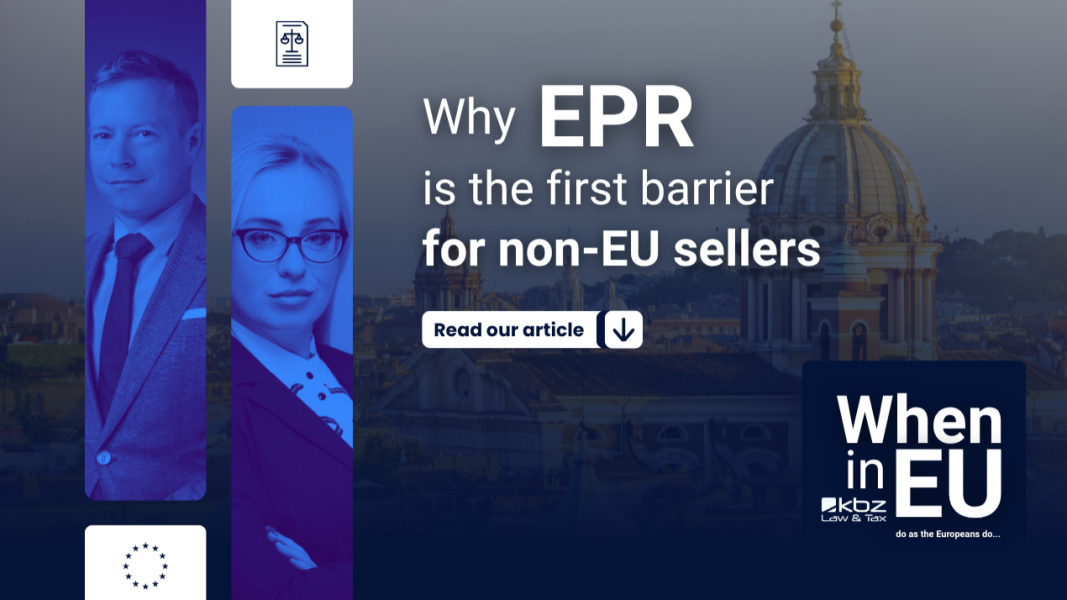
When in EU | Why EPR is the first barrier for non-EU sellers
If you are a non-EU company selling products in Europe, there is one rule you cannot afford to overlook: EPR – Extended Producer Responsibility.
EPR is often categorised as an environmental policy. In practice, it functions as a legal condition for market access.
Under EU law, producers placing products on the market may be required to finance and organise the collection, treatment, recycling and recovery of waste generated by those products. The legal framework stems primarily from:
• Directive 2008/98/EC on waste (Waste Framework Directive)
• Directive 94/62/EC on packaging and packaging waste
• Directive 2006/66/EC on batteries and accumulators
• the recently adopted Packaging and Packaging Waste Regulation (PPWR)
What EPR means in practice
EPR means that companies placing products on the EU market must take responsibility for the post-consumer phase of those products – covering packaging, electronics (WEEE) and batteries. This responsibility translates into mandatory registration, reporting obligations, environmental fees and cooperation with recycling organisations. In many EU countries, these obligations must be fulfilled before products are offered for sale.
Why this matters for e-commerce
Marketplaces such as Amazon are no longer neutral platforms – they actively verify EPR compliance. Without valid EPR registration numbers, listings may be blocked, accounts suspended and expansion into Europe halted overnight. This is particularly visible in Germany and France, where marketplace enforcement mechanisms are already well developed.
What we see in practice
Many international sellers focus on logistics, pricing, customs and marketing. Fewer take early account of regulatory compliance – which is frequently the first real barrier they encounter in the EU.
We regularly work with international clients who already sell in Europe without full compliance, receive urgent requests from marketplaces, or assume that registration in one EU country covers the whole Union. In most cases, the issue is not legal complexity but a lack of early planning.
Takeaway
For any company entering the EU market, EPR is a practical licence to sell.
In the next article, we explain who exactly must comply and why non-EU sellers face stricter obligations.
Partner | Advocate
Senior Counsel | Advocate
Latest Posts
 by Dominika Dudek
KBZ Law & Tax now also in Warsaw
To meet the needs of our clients and stay closer to their business, KBZ Law & Tax is now also available in Warsaw – at The Warsaw HUB, Rondo...
by Dominika DudekNIS2/KSC – is your company subject to the new requirements?
3 October 2026 is an important deadline for businesses falling within the scope of the new KSC/NIS2 requirements. Entities meeting the statutory criteria...